Suppose a newly delivered hose assembly threads onto the pump port for three turns and then binds. Forcing it a little more creates a connection that looks right but leaks as soon as the system reaches operating pressure. In field service, mismatched hydraulic fitting threads cause leaks, stripped ports, and lost production time far more often than a defective hose does. Understanding thread families, and how to identify them, solves most of these problems before they start.
Why Hydraulic Fitting Threads Matter
Threads on hydraulic fittings do more than hold parts together. They generate clamping force, and in some designs they are the only sealing element. If the thread standard is wrong, the seal geometry is wrong too. The result can be a slow weep, high-pressure oil spray, contamination intrusion, or a fitting that blows off under pressure.
NPT-style tapered threads wedge together to seal, which works for low-pressure circuits but can loosen under vibration.
Straight-thread connections such as JIC and ORFS depend on precise seat angles and O-ring positions, not on thread interference.
Mixing a 55 degree BSP thread with a 60 degree NPT thread of similar diameter usually jams after a few turns.
A single misidentified thread can drive rework, extra freight, and machine downtime that far exceeds the cost of the fitting itself.
The Main Hydraulic Fitting Thread Families
The hydraulic industry works with a limited set of thread standards. The list below covers the ones you will meet most often.
NPT and NPTF
A National Pipe Tapered thread has a 60 degree thread form and tapers 3/4 inch per foot. The wedge action of the tapered threads forms the seal. NPTF, the Dryseal version, is machined so that crests and roots deform slightly and seal without additional sealant. NPT threads are common on fluid-power accessories in North America. For high-pressure hydraulic systems, they are generally avoided because vibration can loosen the joint and the thread roots create spiral leak paths.
JIC 37 Degree Flare (SAE J514)
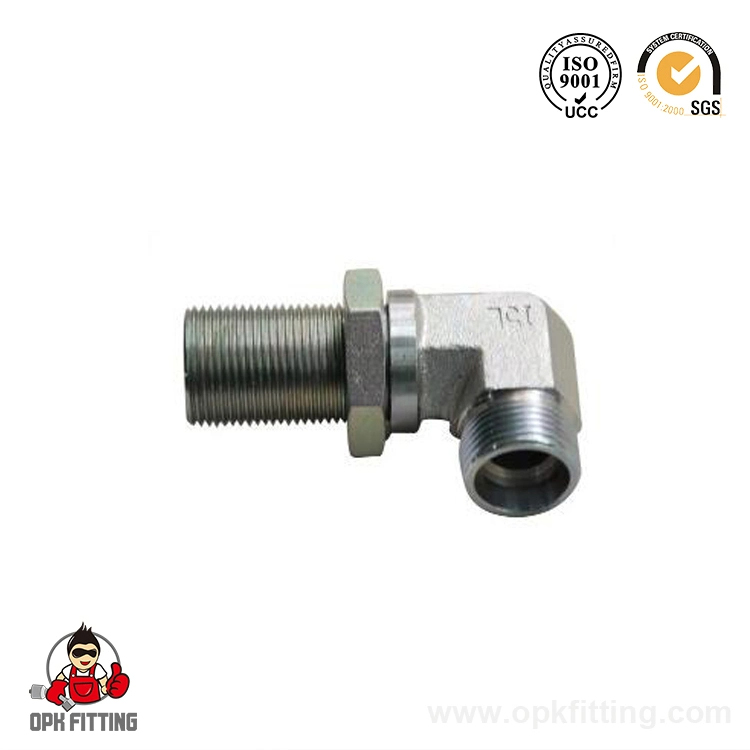
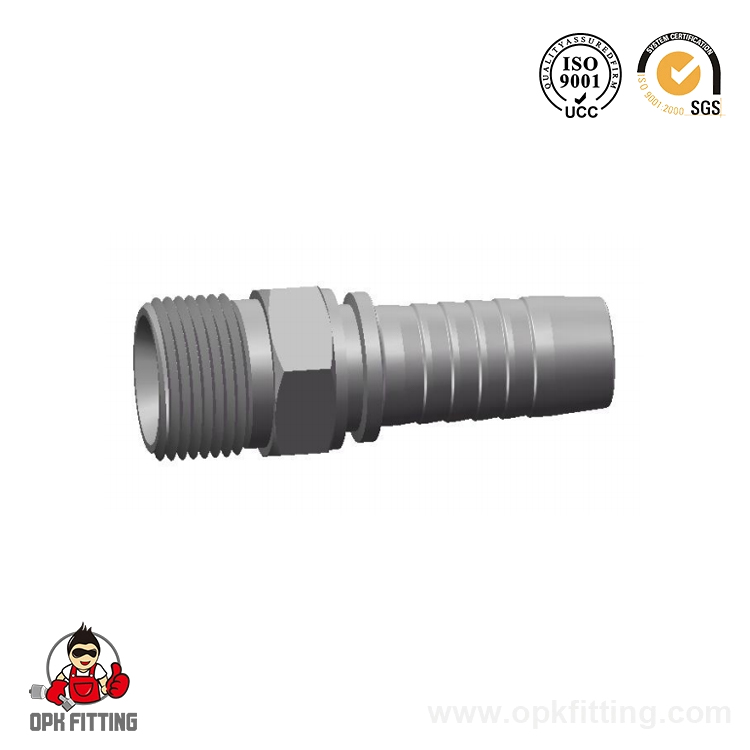
The JIC connection uses straight UNF threads and a 37 degree flare cone. The male flare seats on the female cone in metal-to-metal contact. No sealant or washer is required. Because the sealing surfaces are conical, the joint stays tight over repeated assembly cycles. JIC is widely used for hose assemblies and tube connections in industrial and mobile hydraulics. For ready-made hose ends, our JIC male 74-degree cone fittings are machined to the same SAE J514 geometry.
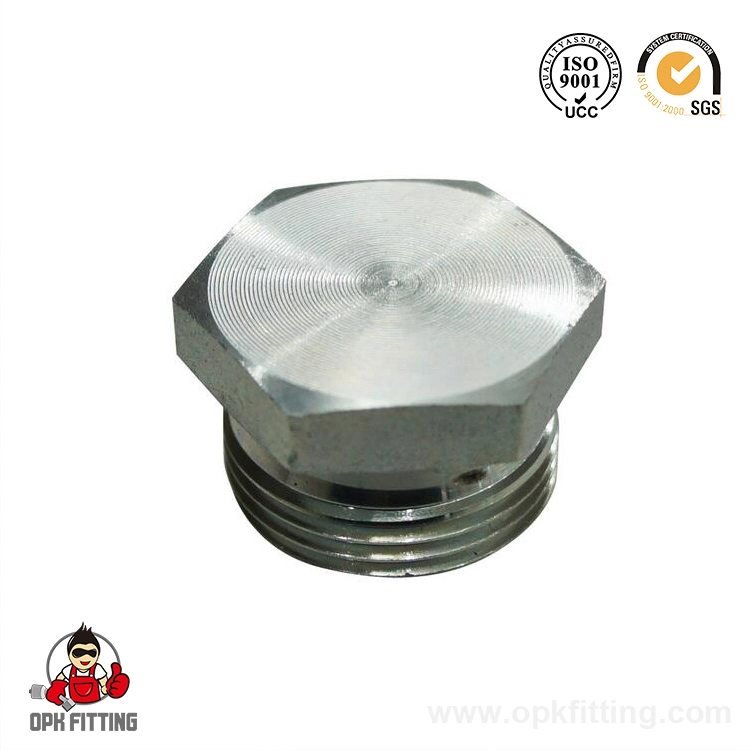
ORFS uses straight threads to pull a flat male face firmly against an O-ring seated in a groove on the female face. The O-ring supplies the seal; the threads only supply clamping force. This makes ORFS one of the most reliable connection types for high-pressure and high-vibration lines. It is also forgiving during assembly because the O-ring compresses within a defined groove. Our ORFS male O-ring seal fittings follow the standard SAE J1453 face-seal profile for hydraulic hose ends.
British Standard Pipe appears as parallel (BSPP) and tapered (BSPT) forms. Both use the 55 degree Whitworth thread form. In hydraulics, BSPP ports usually seal with a bonded washer, an O-ring, or a 60 degree cone seat machined into the port. BSPT seals on the threads. BSP threads look similar to NPT threads but are mechanically incompatible because the angles and pitch differ. For 60 degree cone-seat ports, BSP male 60-degree cone seat fittings offer a direct match for BSPP male assemblies.
The DIN 2353 / ISO 8434-1 24 degree cone system is standard on many European machines. Tube ends are flared or cut to a 24 degree cone, then held by a nut and cutting or O-ring sleeve. ISO 6149 defines a metric straight-thread port with an O-ring seal, which looks like ORFS but uses metric threads. JIS 60 degree cone fittings, common on Japanese equipment, pair a BSPP-compatible thread with a 60 degree seat. These three metric families are not interchangeable unless the port and seal geometry match exactly.
Four Steps to Identify a Hydraulic Fitting Thread
You can identify almost any hydraulic fitting with a caliper, a thread pitch gauge, and a known reference chart.
Check whether the threads are tapered or parallel. Lay the male end on a flat surface and look along the thread profile. Tapered threads (NPT, BSPT, NPTF) step down toward the end. Parallel threads (JIC, ORFS, BSPP, metric) hold the same diameter.
Measure the pitch with a gauge. Imperial connections use threads per inch; metric connections use millimeters per thread. Write down the pitch and the major diameter from a caliper.
Identify the sealing method. Look for a 37 degree cone, a 45 degree cone, an O-ring groove, a flat face, a 24 degree cone, or a tapered thread. The seal geometry is the fastest clue to the thread family.
Compare your numbers with a standard chart for that seal type. A thread like 9/16-18 UNF appears on JIC, ORFS, and some BSP adapters; the seat geometry decides which one you actually have.
Hydraulic Fitting Thread Comparison
The table below summarizes the differences between the main fitting families.
Table 1. Major hydraulic fitting thread families and their seal features.
Thread family
Thread angle
Seal mechanism
Common standard
Typical use
NPT / NPTF
60 degrees
Tapered thread wedging
ANSI B1.20.1 / B1.20.3
Instrumentation, low-pressure lines, North America
JIC
60 degrees (UNF thread)
37 degree metal flare
SAE J514
General hydraulic hose assemblies
ORFS
60 degrees (UNF thread)
O-ring face seal
SAE J1453
High-pressure, high-vibration lines
BSPP
55 degrees
Washer, O-ring, or 60 degree cone
ISO 1179 / ISO 228
European pumps, valves, and cylinders
BSPT
55 degrees
Tapered thread wedging
ISO 7
Low-pressure piping and adapter connections
Metric 24 degree cone
60 degrees
24 degree cone with sleeve or O-ring
ISO 8434-1 (DIN 2353)
European hydraulic tube systems
JIS 60 degree cone
60 degrees (metric or BSPP)
60 degree metal cone
JIS B8363
Japanese-built machinery
Sealing Methods in Cutaway View
The three sealing principles in isometric comparison: a conical flare (JIC), a compressed O-ring (ORFS), and a wedging tapered thread (NPT/BSPT).
Common Mistakes and What They Cost
NPT versus BSPT: both are tapered and easy to confuse. Because the 60 degree NPT and 55 degree BSP forms differ, they start to thread but bind before sealing. If forced, the port can crack.
JIC versus SAE 45 degree flare: a 37 degree cone and a 45 degree cone are visibly similar on a worn fitting. A wrong flare spreads under torque and leaks on the first pressure cycle.
ORFS versus ISO 6149: both use flat faces with an O-ring, but the thread pitch differs. Cross-threading destroys the port.
Reusing damaged ferrules or flare seats: small nicks create leak paths that no torque setting can close.
Choosing the Right Fitting for Your Application
Start from the component port, not from the hose. Check the port standard, then match the hose-end or adapter. Consider working pressure, vibration, frequency of assembly, temperature, and routing space. Material choice also affects the joint: steel resists corrosion and galling better than zinc-plated carbon steel, and stainless steel adds weight and cost. For more on material selection, see this overview of hydraulic pipe fitting materials. If you can identify the port but need a second opinion on the exact thread, contact the OPK factory team and include your thread gauge readings and clear photos.
Frequently Asked Questions
What is the difference between NPT and BSP hydraulic threads?
NPT uses a 60 degree thread form and BSP uses a 55 degree thread form. Both have tapered versions but the angles and pitch differ, so they are not interchangeable. NPT is most common in North America; BSP dominates European and Asian fittings.
Can I use PTFE tape on JIC 37 degree flare fittings?
No. JIC seals through metal-to-metal flare contact. Tape fragments can enter the hydraulic fluid, contaminate valves, and block orifices. It also prevents the flare from seating fully.
How can you tell if a fitting is JIC or SAE 45 degree?
Measure the flare or seat angle with a profile gauge. JIC parts use a 37 degree cone; SAE 45 degree parts use a 45 degree cone. The two look alike at a glance but never form a leak-free joint when mixed.
What does ORFS stand for?
ORFS means O-Ring Face Seal. The connection uses straight threads to press a flat male face against an O-ring in the female face. The O-ring provides sealing, which gives excellent leak resistance under pressure and vibration.
Which hydraulic fitting thread is best for high pressure?
ORFS and SAE flange connections are the usual choice for high-pressure systems in the 3000-6000 psi range, followed by JIC 37 degree flare and DIN 24 degree cone designs. The correct answer also depends on hose size, impulse loads, and assembly access.
How do I measure the thread size of a hydraulic fitting?
Measure the major diameter with calipers and the pitch with a thread pitch gauge. Then match both against a standard chart for the identified seal type. Include the seat form in your record; it matters as much as the thread size.
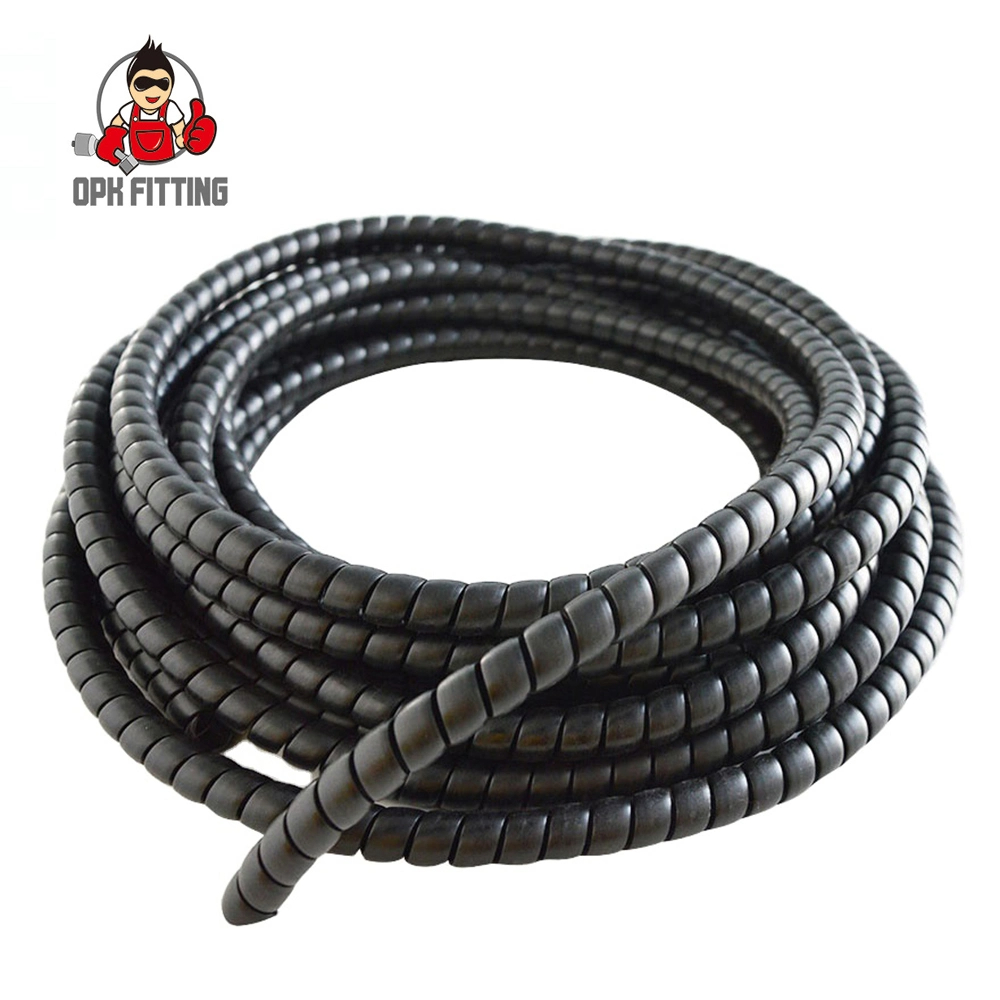
PRODUCT NAME: Spiral Protective Sleeve PP plastic hose guard for hydraulic hoseRecommended For: The use of Spiral Guard Wrap is an economical and conv...



.jpg)
.jpg)
-1.jpg "Metric Male 74 Degree Cone Fitting/Sea O-Ring Boss L-Series ISO 11926-3 (1QO, 1QO-RN)")