During a routine hose replacement on an excavator, a maintenance crew fitted a replacement that looked identical to the old one: same hex size, same thread pitch reading on a simple gauge. The circuit leaked as soon as pressure passed 200 bar. The replacement was BSPT; the port was NPT. Visually close, dimensionally different, completely incompatible.
That story repeats in every workshop that stocks hydraulic fitting types from more than one standard. Hydraulic fittings are not interchangeable by appearance. Each type is defined by its thread form, its seat angle, and its sealing principle — and those three details decide whether a connection holds pressure for years or fails in minutes.
This guide explains the main hydraulic fitting types, how to identify them, and where each one belongs. If you are sourcing hose assemblies or adapters in volume, knowing these differences also helps you ask the right questions about material, plating, and crimp quality.
Why the Industry Produced So Many Fitting Types
Hydraulics developed in parallel in North America, the United Kingdom, Germany and Japan. Each region standardized its own thread and sealing system for local manufacturing, and those systems became embedded in equipment that is still in service today. NPT grew out of plumbing; JIC was developed to survive vibration in mobile machinery; DIN produced a high-pressure 24° cone system; JIS followed British 60° cone practice with its own thread.
As operating pressures rose, face-seal designs such as ORFS appeared to eliminate the small leaks that taper threads tolerate.
Understanding the family comes down to three variables:
Thread form: tapered or parallel, with a specific flank angle and pitch.
Sealing principle: metal-to-metal contact, O-ring compression, or thread wedging.
Table 1 — Hydraulic fitting types and their main identification features
Fitting family
Thread form
Sealing principle
Typical applications
NPT
Tapered pipe, 60° flank
Thread wedging plus sealant
Air, water, low and medium pressure hydraulics
BSPT
Tapered Whitworth, 55° flank
Thread wedging plus sealant
European and Asian industrial circuits
BSPP 60°
Parallel Whitworth, 55°
60° metal cone or face O-ring
UK and European machines, valves, cylinders
JIC 37°
Parallel UNF, 60°
37° flared metal cone
Mobile equipment, machine tools
ORFS
Parallel UNF, 60°
O-ring compressed against flat face
Leak-critical high pressure systems
Metric 24° (DIN 2353)
Parallel metric, 60°
24° cone, with or without O-ring
DIN-standard machines, high pressure circuits
JIS 60°
Parallel metric, 30° flank
60° metal cone
Japanese construction and industrial equipment
Three Ways a Hydraulic Fitting Seals
Nearly every hydraulic fitting type relies on one of three sealing strategies.
Metal-to-metal cone — JIC 37°, BSP 60°, JIS 60°, and metric 24° without O-ring. A machined cone presses against a matching seat with high contact stress. It tolerates vibration well but is sensitive to scratches on the seating surface.
Soft seal (O-ring) — ORFS and metric 24° cone with O-ring (DIN 3865). An elastomer takes the sealing load, so minor damage to the face does not cause leaks. These types dominate high-pressure and leak-critical locations.
Tapered thread — NPT and BSPT. The thread itself seals by wedging and slight deformation, assisted by sealant. It is simple and cheap, but the weakest option under severe vibration.
Each approach has a different practical pressure ceiling. The chart below shows typical maximum working pressure values for steel fittings in common sizes.
Figure 1 — Typical maximum working pressure values for steel fittings in common sizes. Exact ratings depend on size, material and manufacturer.
Main Hydraulic Fitting Types at a Glance
NPT and BSPT: tapered threads
NPT (National Pipe Taper) seals through thread interference; BSPT (British Standard Pipe Tapered) does the same with a 55° flank instead of 60°. Both suit simple circuits below roughly 350 bar, but they vibrate loose and need sealant. Never pair NPT with BSPT: the threads can catch for a few turns and then leak or split the port.
JIC 37° flare
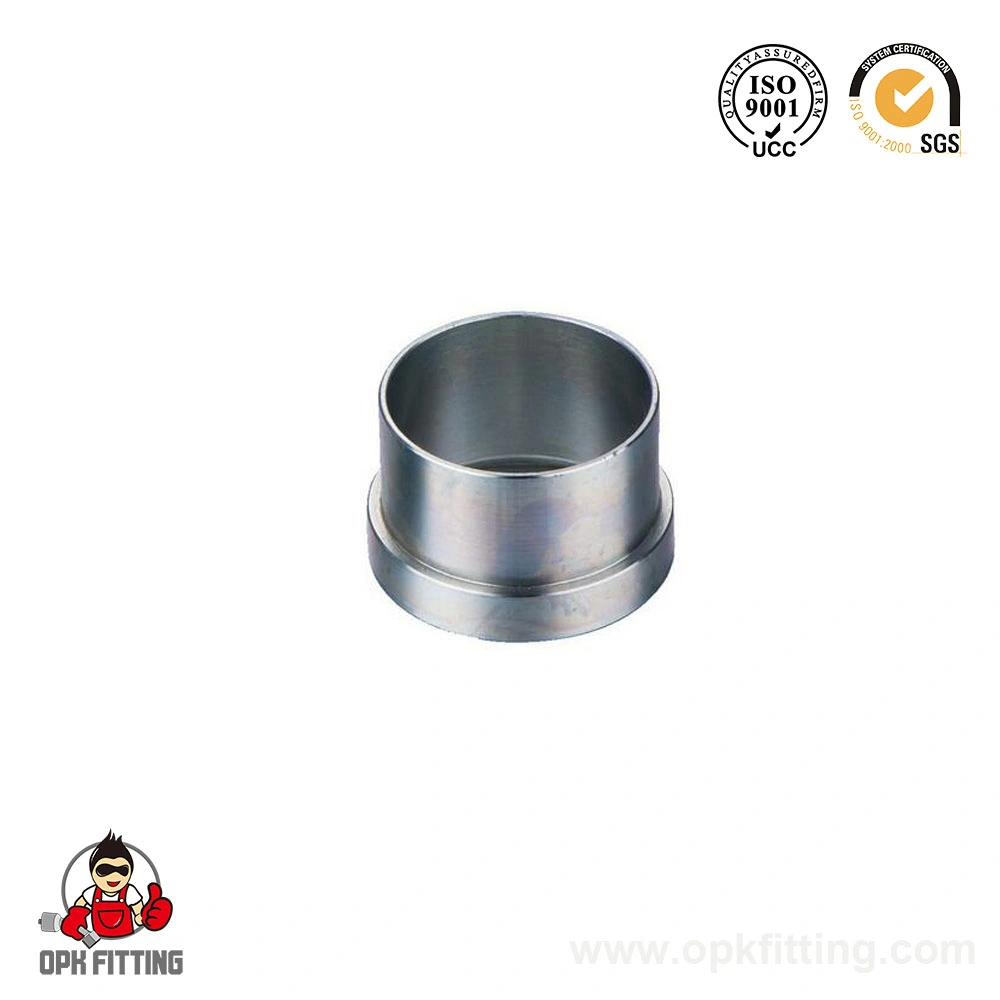
JIC (SAE J514) pairs a parallel UNF thread with a 37° male flare and a matching 37° female seat. The metal cone provides a solid seal at medium-high pressure and is the default choice in mobile hydraulics. One-piece versions eliminate the separate sleeve that can slip during assembly. For JIC applications, OPK supplies JIC 74° cone male fittings with plated carbon steel bodies and precise cone geometry.
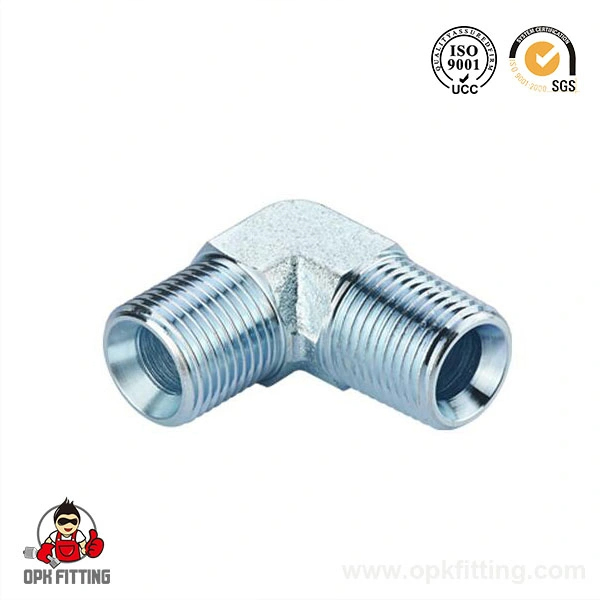
BSP appears in two forms. BSPP is parallel and seals either on a 60° metal cone or with a face O-ring; BSPT is tapered and seals on the threads. The 55° Whitworth thread profile distinguishes BSP from American and metric threads. BSP 60° cone fittings are common on European gear pumps, valves, and cylinders. The BSP male 60° cone seat fittings cover the straight male version used in most hose assemblies.
ORFS (SAE J1453) compresses an O-ring inside a groove against a flat face. With no metal-to-metal seating, the joint resists leakage better under pressure spikes and vibration, and it can be assembled and disassembled many times by replacing the O-ring. Most manufacturers rate ORFS fittings for pressures up to about 420 bar (6000 psi) in suitable sizes.
Metric 24° cone fittings
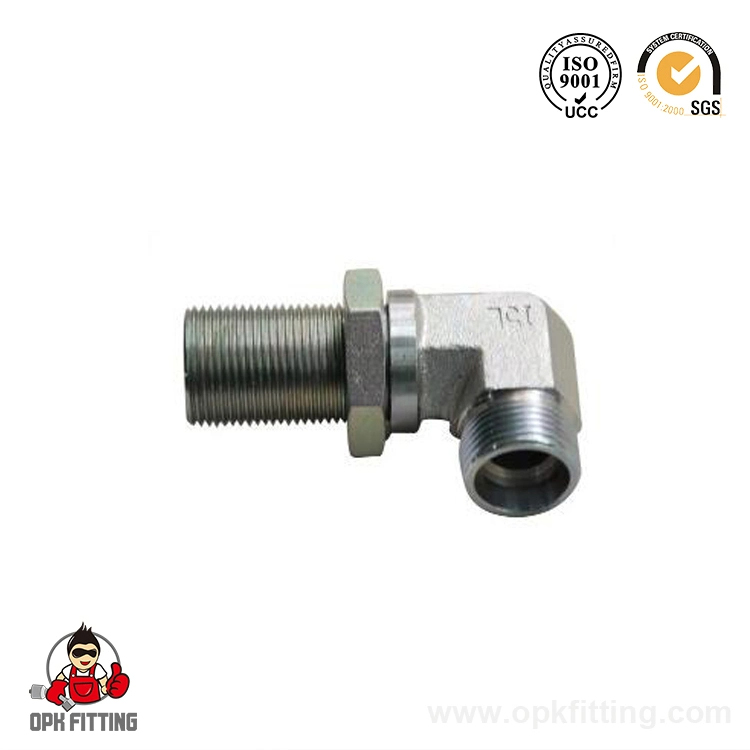
Widely used outside North America, the metric 24° cone system (DIN 2353 / ISO 8434-1) comes in light (L) and heavy (S) series. Light series covers typical systems to around 315 bar; heavy series extends higher, depending on size. An O-ring version (DIN 3865) adds a soft seal behind the cone. Metric 24° cone male fittings with L-series thread are specified when equipment requires the DIN light series.
Japanese excavators, injection molding machines, and machine tools commonly use JIS B8363 fittings with a 60° cone and metric threads with a 30° flank. The cone angle looks identical to BSP's 60°, so the thread pitch and flank angle must be verified before assembly.
Crimped, Reusable or Socketless? Attachment Styles Matter
The body shape is only half of the decision; the way the fitting attaches to the hose determines service life and field repair options.
Crimped — The ferrule is pressed with a crimping machine to a controlled diameter. This gives the best connection quality, but it requires a shop press. OPK's production process includes cutting, skiving, crimping, and pressure testing.
Reusable (field attachable) — You screw or clamp the fitting onto the hose without a press. This is commonly used on SAE 100 R5 hose and other textile-reinforced hoses for quick repair.
Socketless — For low-pressure return lines, the fitting bites into the hose and requires no clamping at all. These socketless hose fitting designs reduce part count and assembly time.
Figure 2 — Exploded view of a typical crimped hose assembly: hose, ferrule, nipple, hex body and male thread.
Materials, Pressure Ratings and Selection
Most hydraulic fitting types are manufactured in carbon steel with zinc plating, stainless steel, or brass. Zinc-plated carbon steel is the economic standard for mobile and industrial circuits; stainless suits food, pharma, marine and other corrosive environments; brass appears in low-pressure instrumentation.
Identify the port thread with a pitch gauge and caliper.
Confirm the seat: cone angle, flare seat, or flat face with O-ring.
Match hose dash size to the fitting tail size.
Check pressure rating and impulse requirement against the circuit.
Verify orientation (straight, 45°, 90°) for clean routing.
Figure 3 — Qualitative comparison of sealing reliability, pressure capability, vibration resistance, assembly ease and reusability. Ratings are indicative.
ORFS scores highest for leak resistance; JIC balances assembly ease with vibration performance; NPT remains serviceable for low-cost circuits but falls behind on vibration and leak integrity.
Common Identification Mistakes
Confusing NPT with BSPT because both are tapered — their flank angles and pitches are different.
Assuming every 60° cone is BSP: JIS also uses 60°, with a 30° thread flank.
Mixing straight threads and pipe threads: they can start, then seize without sealing.
Reusing a metal cone fitting that has been over-torqued; the cone deforms and no longer seats.
Choosing stainless fittings without confirming that thread and seat geometry match the mating component.
Frequently Asked Questions About Hydraulic Fitting Types
Q1. Can I connect an NPT fitting to a BSPT port?
No. NPT has a 60° thread flank and different pitch from BSPT's 55° Whitworth form. The threads may engage for a turn or two and then bind, leak, or crack the port. Use a proper adapter.
Q2. How do I tell a JIC 37° fitting from a BSP 60° fitting?
Check the thread rather than the seat. JIC uses UNF threads with a 60° form; BSP uses Whitworth threads with a 55° angle and rounded roots. A thread pitch gauge identifies the difference immediately.
Q3. What does a dash size like -6 mean in hydraulic fittings?
It refers to the nominal inside diameter in sixteenths of an inch: -6 equals 6/16 in (3/8 in) and -8 equals 1/2 in. Dash size also correlates with the nominal thread size of the fitting.
Q4. Which is better for high pressure, ORFS or NPT?
For high-pressure hydraulic circuits, ORFS is generally better because the O-ring face seal resists leakage under pressure spikes and vibration. NPT tapered threads are simpler and cheaper but more prone to loosening in demanding service.



.jpg)
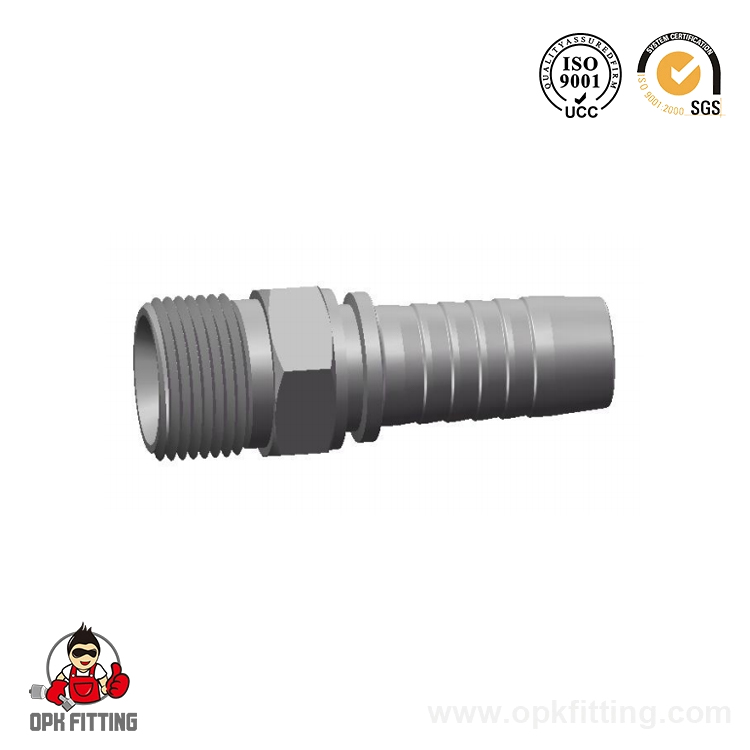
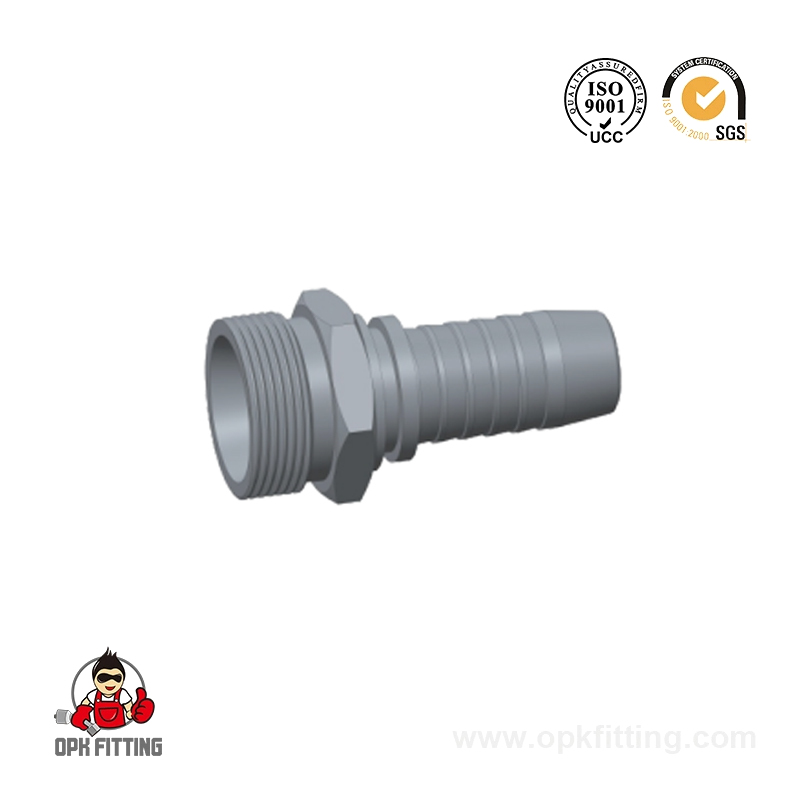
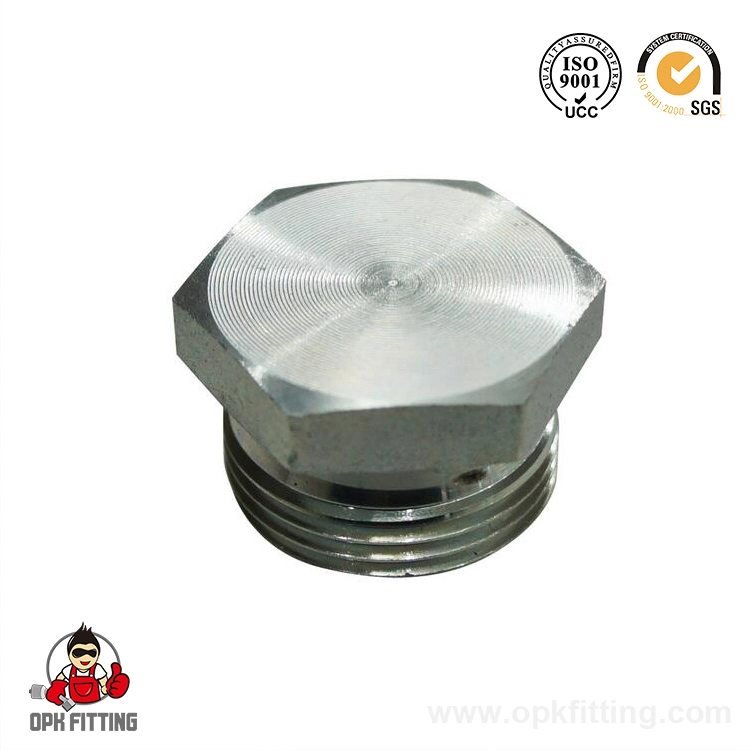
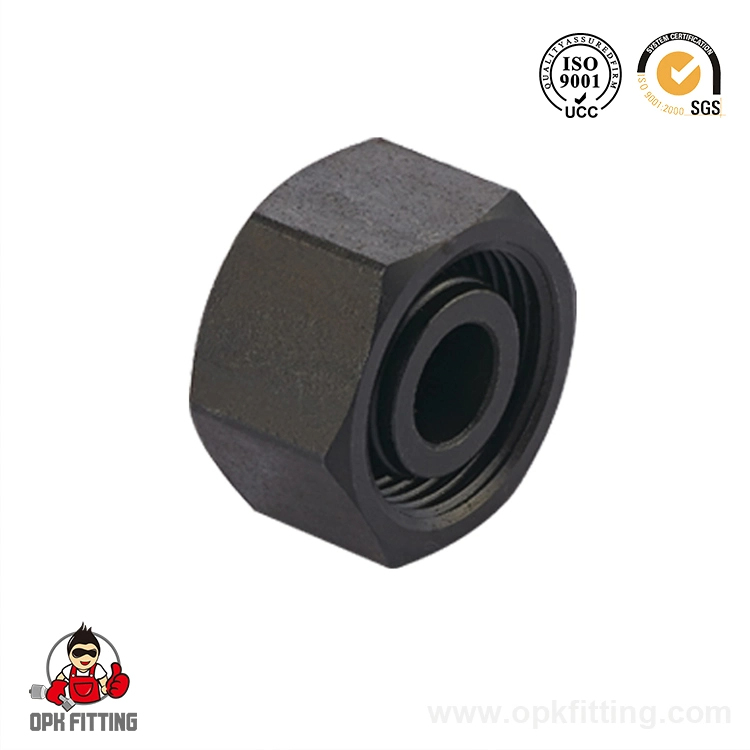
-1.jpg "Metric Male 74 Degree Cone Fitting/Sea O-Ring Boss L-Series ISO 11926-3 (1QO, 1QO-RN)")